In the real estate industry, growth is often highly visible. Public recruitment campaigns, commission incentives, social media announcements, and high-energy expansion events are common strategies used to attract agents and staff. Visibility has its place. However, the most sustainable and profitable real estate businesses I advise are expanding in a far more deliberate way, quietly, strategically, and in alignment with a long-term vision.
As an HR consultant and recruiter specializing in real estate, I have seen how aggressive expansion can destabilize otherwise healthy organizations. When growth outpaces infrastructure, culture begins to dilute, operational gaps widen, and client experience becomes inconsistent. Internal friction follows, expectations become misaligned, and profitability often erodes.
In business, we frequently measure achievement by scale. Yet true organizational strength is not measured by how tall the building stands, but by how well the foundation supports it over time.
Confidential and intentional recruitment is a disciplined approach to hiring that prioritizes alignment, capability, and sustainability over optics. Instead of announcing broad hiring initiatives, leaders first evaluate their internal environment. They assess operational gaps, anticipate future capacity requirements, and define the competencies needed to support both current performance and future growth.
In an industry built on reputation and trust, discretion is not simply a preference; it is a strategic asset. High-volume agents and teams exploring new opportunities often require confidentiality. Brokerages planning expansion may wish to avoid premature speculation among competitors, agents, or internal teams. Quiet recruitment respects these realities while allowing leadership to maintain control over messaging, timing, and organizational impact.
Practical tip: Before expanding the team, document where your business is operationally constrained today and where it will be constrained in 12 to 24 months. Recruit against future bottlenecks, not current stress points.
Moving Beyond the Numbers Game
Real estate frequently frames expansion as a volume-driven equation: more agents, more listings, more transactions. Yet increased headcount does not automatically translate into increased stability or profitability. I have worked with teams that expanded rapidly, only to struggle with inconsistent service standards, strained systems, and cultural fragmentation, which often resulted in the demise of the business unit and fractured relationships. Leaders must understand what capabilities the business requires today and what roles will be critical in a few years. They must identify operational bottlenecks that limit scalability and determine which additions will enhance client experience while mitigating risk. Recruitment should be driven by these strategic questions, not market trends, competitor behaviour, or ego metrics.
Practical tip: Align hiring decisions with your business plan. If your goal is to scale volume, invest in operations first. If your goal is premium service, invest in client-facing and quality control roles.
Alignment Over Incentives
Compensation structures are often used as primary recruitment tools within real estate. While remuneration is important, it is rarely the determining factor in long-term organizational cohesion. Sustainable teams are built on alignment, shared values, compatible service philosophies, professional standards, and mutual accountability.
Intentional recruitment shifts focus toward cultural compatibility, work ethic, client service philosophy, and integrity. These attributes are far more predictive of long-term success than commission splits alone. Compensation models can be adjusted. Values and behavioural patterns are significantly harder to correct once embedded.
Practical tip: Build a structured interview framework that assesses values, decision-making style, and client service philosophy, not just production metrics.
Placing the Right People in the Right Roles
Organic growth requires clarity not only about who to hire, but why. Expansion does not always mean increasing agent headcount. In many cases, strengthening administrative and operational infrastructure yields far greater returns.
Adding a licensed administrator can reduce compliance risk. A transaction coordinator can elevate client communication and consistency. A buyer specialist can leverage existing lead generation systems. A marketing or operations professional can reinforce brand positioning and internal efficiency. These roles often unlock scale more effectively than adding additional agents.
Quiet recruitment allows leaders to fill these positions without destabilizing team dynamics or creating unnecessary internal speculation.
Practical tip: Conduct a role design exercise before hiring. Define outcomes, workflows, and success metrics for the role rather than relying on generic job titles.
Building Resilience in a Cyclical Market
Real estate is inherently cyclical. Interest rates fluctuate, consumer sentiment shifts, and transaction volumes rise and fall. Organizations built on rapid expansion and aggressive recruitment often struggle when market conditions tighten. Conversely, businesses grounded in structure, clarity, and cultural cohesion demonstrate far greater resilience.
Intentional hiring strengthens an organization in measurable ways. Processes become documented and standardized. Accountability structures are clearly defined. Service delivery remains consistent. Team members understand expectations and performance benchmarks. This operational discipline allows a business to withstand volatility without sacrificing morale, client relationships, or talent retention.
Practical tip: Pair every hire with documented processes and clear KPIs. Hiring without structure amplifies chaos.
Discretion as Leadership Discipline
Confidential recruitment is not secrecy for its own sake. It reflects strategic leadership. It signals that decisions are being made thoughtfully and aligned with organizational needs rather than public momentum.
Discretion allows leaders to protect strategic growth plans, safeguard candidate confidentiality, maintain internal stability, and preserve brand integrity. In practice, this often involves direct outreach, structured vetting, and carefully managed interview processes. Candidates value professionalism and clarity. Leadership values control and intentionality.
Practical tip: Use a third-party recruiter or internal confidential search process to approach candidates discreetly, especially when hiring senior or visible roles.
Growth as a Long-Term Strategy
The most effective real estate leaders integrate workforce planning into their broader business strategy. Recruitment is not reactive; it is anticipatory. Talent decisions are aligned with revenue forecasting, operational scalability, client service standards, and brand positioning.
Quiet, organic growth creates space for disciplined decision-making. It allows businesses to expand role by role, strengthening infrastructure in parallel with production, rather than racing ahead of capacity.
Strong Foundations Endure
The real estate industry often celebrates scale, large teams, high transaction volumes, and visible brand presence. Yet the most enduring organizations are frequently those operating with less spectacle and greater precision. They invest in systems. They develop their people. They hire selectively. They prioritize alignment over acceleration.
The objective is not to be the loudest presence in the marketplace. It is to be the most trusted, cohesive, and structurally sound.
Intentional, values-driven recruitment remains one of the most effective mechanisms for building that kind of enterprise, one capable of withstanding change, protecting its people, and delivering consistent excellence over time.
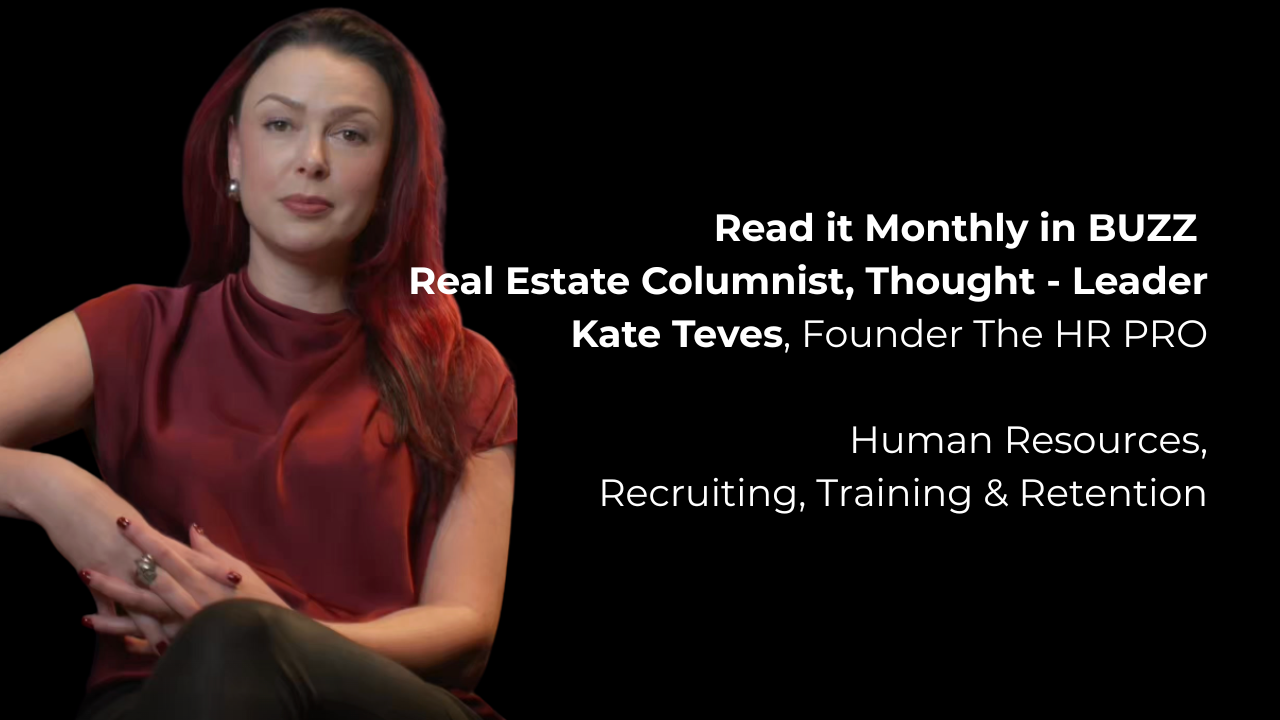
Kate Teves, Founder The HR PRO, Contributing Editor
To learn more, visit THE HR PRO